
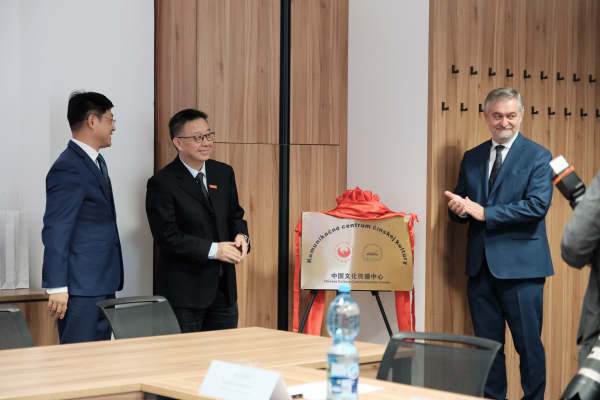
Ľuboš Cibák (right), President of BUEM, Wang Xiaojian (first from left), Chargé d'Affaires ad interim of the Chinese Embassy in Slovakia, and Li Guoping, Vice President of NBUFE, jointly unveil the Chinese Culture Communication Center.
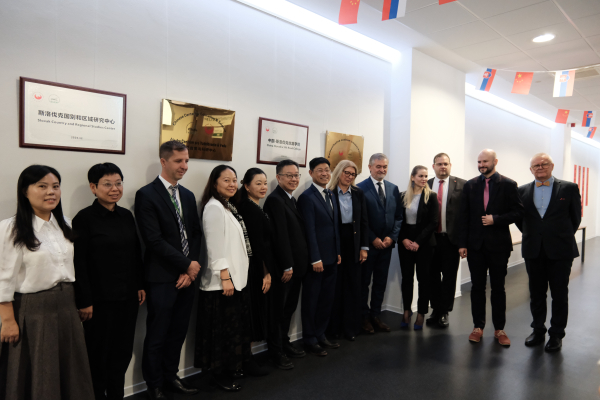
On October 15, our university and Bratislava University of Economics and Management (BUEM) held a special event in Bratislava, Slovakia, to celebrate the 10th anniversary of our partnership and officially launch Chinese Culture Week at the Chinese Culture Communication Center. Wang Xiaojian, Chargé d'Affaires ad interim of the Embassy of the People's Republic of China in Slovakia, attended the event, along with a five-member delegation from our university led by Vice President Li Guoping.
The opening ceremony began with a warm welcome from Ľuboš Cibák, President of BUEM. He expressed his hope that the official inauguration of the Chinese Culture Communication Center would mark a new starting point for expanding academic cooperation, strengthening university-industry collaboration, and encouraging more young people to participate in intercultural exchanges, opening a new chapter in the partnership over the next decade.
In his remarks, Li Guoping reflected on the achievements of the past ten years, comparing the partnership to a seed that, through the dedication and care of both universities, has grown into a flourishing tree. Since establishing their partnership in 2016, the two institutions have leveraged Ningbo's advantages in cooperation with Central and Eastern European countries and opportunities arising from the Belt and Road Initiative to deepen collaboration in joint talent development, scientific research, cultural exchanges, and university-industry integration. These efforts have contributed to the development of a distinctive NBUFE model for international cooperation in higher education.
Wang Xiaojian spoke highly of the achievements made through a decade of educational cooperation between the two universities. He noted that China and Slovakia have long maintained friendly relations and that educational and cultural exchanges form an important foundation of bilateral ties. He described the sustained partnership between NBUFE and BUEM as an example of mutual understanding, learning, and cooperation between universities in the two countries. He also emphasized that the inauguration of the Chinese Culture Communication Center represents another milestone in their ten-year partnership and provides a dedicated platform for cultural exchanges and mutual understanding between China and Slovakia.
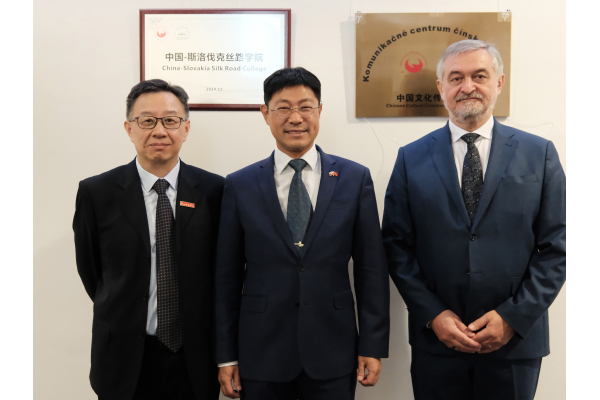
Ľuboš Cibák (right), President of BUEM, Wang Xiaojian (second from left), Chargé d'Affaires ad interim of the Chinese Embassy in Slovakia, and Li Guoping, Vice President of NBUFE, pose for a group photo.
Following the opening ceremony, representatives from the two universities held discussions on faculty and student exchanges, joint education programs, research collaboration, and talent development to support Chinese enterprises operating in Slovakia. The discussions focused on refining plans for the next decade and expanding cooperation from cultural exchanges to deeper integration between higher education and industry. Representatives from both institutions also exchanged commemorative gifts as a symbol of their longstanding friendship.
The event continued with a series of traditional Chinese cultural activities organized by our university’s faculty members and students, who currently studying or visiting in Slovakia. Wang Xiaojian, BUEM representatives, and the delegation of our university participated in the activities and experienced various aspects of China's intangible cultural heritage. Through demonstrations and hands-on experiences in Chinese calligraphy and traditional tea culture, participants gained a deeper appreciation of the artistic traditions and cultural values of China.
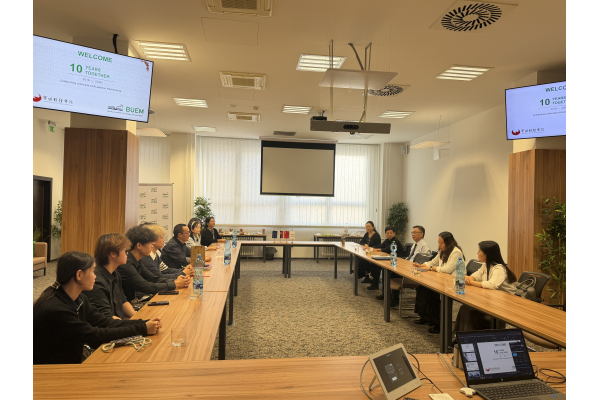
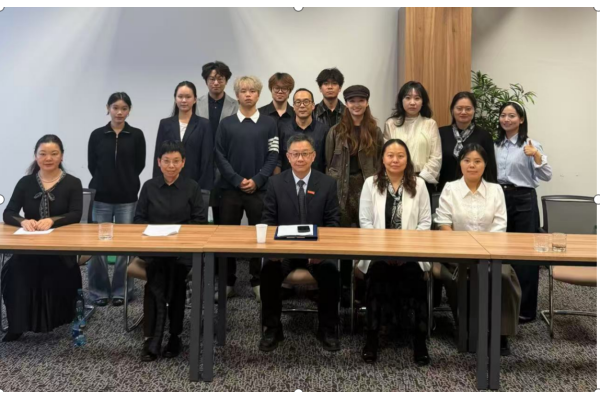
That afternoon, Li Guoping also held a meeting with faculty members and students from our university currently participating in academic visits and exchange programs in Slovakia. During the discussion, participants shared their experiences of academic activities, preparations for Chinese Culture Week, professional studies, and overseas practical learning, as well as their plans for future exchanges. Li listened attentively to their experiences and asked about their academic progress, daily lives, accommodation, and personal safety while abroad. He commended their efforts to promote traditional Chinese culture and actively participate in cultural exchanges between China and Slovakia. He encouraged them to make full use of their international exchange opportunities, broaden their global perspectives, develop independent thinking, and gain meaningful academic and cultural experiences. Last but not least, he also encouraged them to serve as ambassadors of friendship and understanding between young people in China and Slovakia.
As a new platform for cultural and educational exchanges between the two universities, the Chinese Culture Communication Center will provide Chinese language education, promote Chinese culture, and support comparative research on Chinese and Slovak cultures. It will also offer training programs for employees of Chinese enterprises operating in Slovakia and create practical learning opportunities in cross-border trade and commerce. Building on the launch of Chinese Culture Week, the center will organize a series of cultural activities to help more Slovak faculty members and students gain a deeper understanding of China and its traditions. These initiatives aim to strengthen people-to-people ties between China and Slovakia, contribute to the high-quality development of the Belt and Road Initiative, and further promote educational and cultural cooperation between China and Central and Eastern European countries.
(Written by: Hu Rong, College of Foreign Languages; Photography by: Lu Qingchuan, College of Humanities; Reviewed by: Zhu Fengmei, Office of International Cooperation; Wang Rui, Ningbo Municipal Education Bureau)